

Civil Site Engineer Interview: 12 Questions With Short Answers
In a site engineer interview, nobody wants a long lecture. They want to see if you understand the basics and can use them on site. So the answers here are short. Don’t memorise them. Say them in your own words.
1. What does M20 concrete mean?
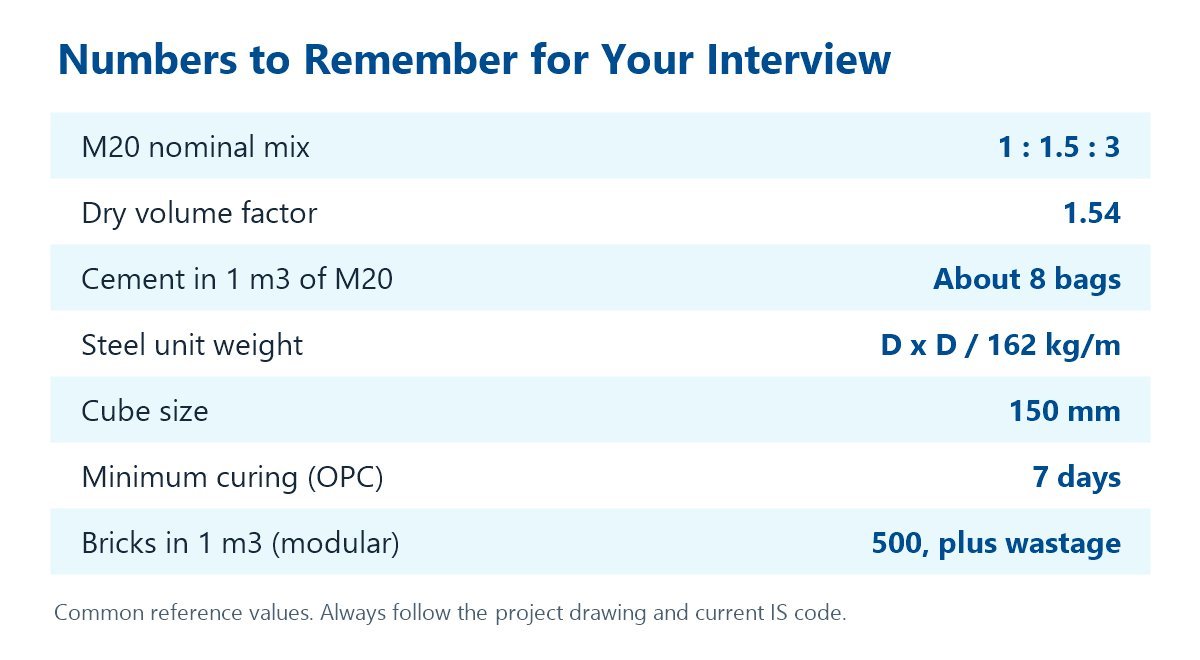
M stands for mix. 20 is the characteristic compressive strength in N/mm² after 28 days. The nominal mix ratio is 1:1.5:3 (cement : sand : aggregate).
2. How many cement bags are needed for 1 cubic metre of M20?
Dry volume = 1 × 1.54 = 1.54 m³. Cement part = 1.54 × 1/5.5 = 0.28 m³. One bag is 0.0347 m³, so 0.28 / 0.0347 = about 8 bags.
3. Why do we multiply by 1.54 to get dry volume?
Dry material has gaps in it. When water is added, the gaps fill up and the volume goes down. So we need more dry material than the final wet volume.
4. How do you find the unit weight of steel?
Use D²/162 kg per metre, where D is in mm. For a 12 mm bar: 144/162 = 0.889 kg/m. The density of steel is 7850 kg/m³.
5. What clear cover is normally used?
Commonly, 20 mm for slabs, 25 mm for beams, 40 mm for columns and 50 mm for footings. The actual value depends on exposure and the drawing, so always check the drawing first.
6. What is the difference between a one-way and a two-way slab?
If long span / short span is more than 2, it is one-way. If it is 2 or less, it is two-way. In a one-way slab, the main steel runs along the short span.
7. Why and when do we do a cube test?
It checks the compressive strength of concrete. We use 150 mm cubes, usually tested at 7 and 28 days. Acceptance is based on the 28-day strength.
8. How many days should concrete be cured?
As per IS 456, at least 7 days for OPC. With mineral admixtures or blended cement, at least 10 days, and longer in hot or dry weather.
9. When can shuttering be removed?
General times from IS 456: vertical formwork for walls and columns, 16 to 24 hours. Slab soffit, 3 days (with props refixed). Beam soffit, 7 days. Slab props, 7 days up to 4.5 m span and 14 days above that. Beam props, 14 days up to 6 m span and 21 days above that.
10. How many bricks are in 1 cubic metre of brickwork?
A modular brick with mortar is 200 × 100 × 100 mm, so 1 / 0.002 = 500 bricks. Add wastage separately.
11. What is honeycombing and why does it happen?
It is small holes in concrete where the aggregate is visible. Causes include poor vibration, steel placed too close together, a poor mix, or slurry leaking from the shuttering.
12. What do you check before casting?
Shuttering level and support, steel diameter and spacing, lap, cover blocks, sleeves, and whether material and the vibrator are ready. Give an example from a project you have seen.
One small tip
If you don’t know an answer, say so honestly: “Sir, I am not sure about this, but I will check it.” That is better than guessing a wrong number. If you have done a site visit or internship, prepare one real example from it. People remember that more than a textbook answer.
For billing, planning, QS and AutoCAD questions, see Interview Question for Civil Engineers. For quick site numbers, see Thumb Rule for Civil Engineers.
Choosing your next book? See our guide to the best construction e-books for civil engineers.

Comments (0)