

First Site Engineer Job: What to Learn in Your First 30 Days
College teaches you design. Then on your first day at site, someone asks, “Did you check the plinth beam level?” That is when you see how different site work is from books.
Don’t worry. Every site engineer starts here. You will not learn everything in 30 days, but you can get these basics right.
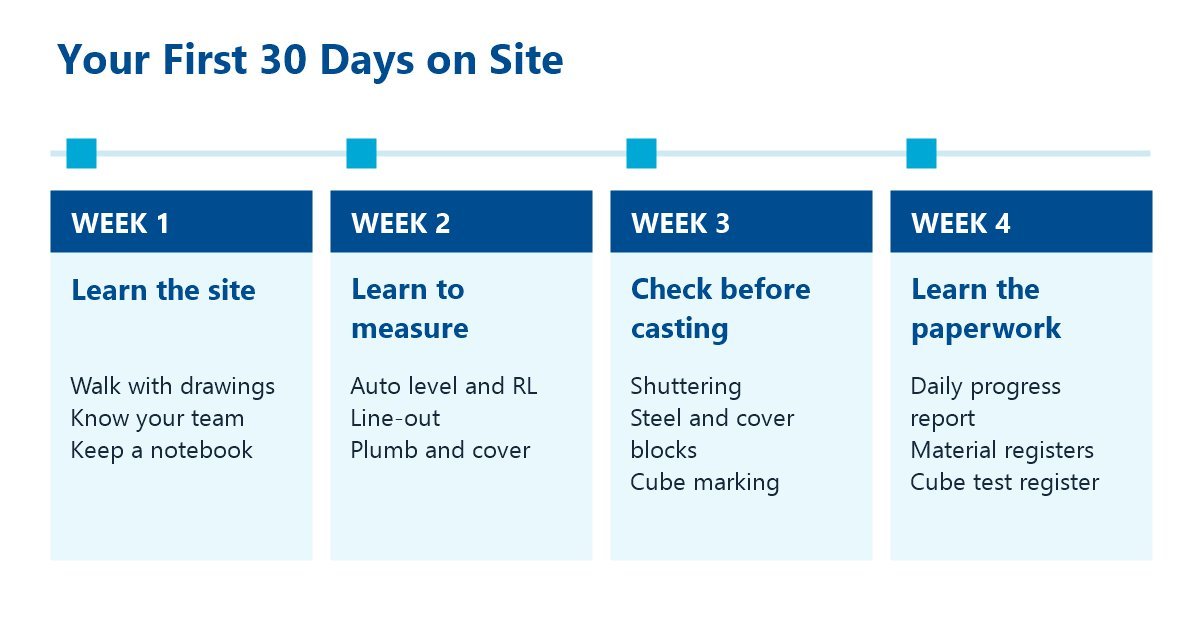
Week 1: Learn the site
Walk the site with the drawings. Take the architectural and structural drawings and go around the whole site. Find each column from the drawing on the actual site. This is the fastest way to learn how to read drawings.
Get to know people. Learn the names of the foreman, bar bender, mason and store keeper. An experienced foreman can teach you things no book covers. But always check what you hear against the drawing.
Keep a small notebook. When you hear a new word, write it down and look it up in the evening. Words like centering, dowel and chajja will soon feel normal.
Week 2: Learn to measure
- Taking levels with an auto level and finding the RL
- Checking column line-out and diagonals
- Checking if a column is plumb
- Checking steel spacing and cover
Do these with a senior first. Then do them alone and ask your senior to verify. A mistake caught now costs little. After concreting, it costs a lot.
Week 3: Check before concreting
Before a slab or beam casting, check these yourself:
- Shuttering level, joints and supports
- Steel diameter, spacing, lap and chairs
- Cover blocks
- Electrical and plumbing sleeves
- Sand, aggregate, cement and a working vibrator
On casting day, make sure cubes are taken and marked with the date and location. If someone later asks about that concrete, this record will answer them.
Week 4: Learn the paperwork
Many new engineers miss this part. If the work is not written down, it is hard to prove it was done.
- Daily progress report: work done, labour count and material received
- Cement and steel registers
- Cube test register
- Hindrance register, if work stops for any reason
Spend 15 minutes on this every day. If you fill it from memory at the end of the month, you will make mistakes.
Three mistakes to avoid
Saying yes when you are not sure. If you don’t know, say, “I will check and tell you.” A wrong yes causes more damage.
Using an old drawing. Check the revision number before starting work. A column built from the wrong drawing may have to be broken.
Staying in the office. The Excel work can wait. When work is going on at site, be there. That is where you really learn.
What to read next
The Site Engineer Handbook covers daily site work, and the Construction Checklist helps with inspections. For register formats, see Daily Formats for Site Engineers. Reading helps, but you learn most by checking things yourself on site.
Choosing your next book? See our guide to the best construction e-books for civil engineers.

Comments (0)